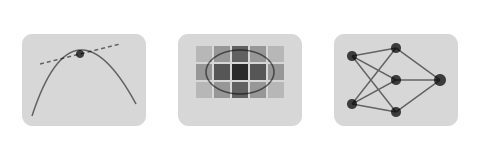
Mathématiques, Vision, Apprentissage (MVA)
Master 2 research programme of ENS Paris-Saclay, co-accredited with Institut Polytechnique de Paris and shared with Université Paris Cité
Official description of the master
The MVA is a 2nd year Master’s Research programme which started in 1996, run by the mathematics department of ENS Paris-Saclay, co-accredited with the Institut Polytechnique de Paris and shared with Université Paris Cité. The Master’s in MVA is unique in France for its scientific focus on mathematical interfaces and its openness to an innovation ecosystem that brings together academic laboratories, research organisations and companies in France and abroad.
In cooperation with several academic partners, it trains a large number of university and “grandes écoles” students each year in Research, Development and Innovation for public and private organizations and companies in the field of mathematics applied to data, image and signal processing. The huge growth in the use of digital data in all fields of science, technology and society requires the training of high-level mathematical researchers mastering the acquisition and processing of digital data on the one hand, and their automatic interpretation on the other. These two aspects are strictly complementary and are reflected in the three terms characterizing the MVA program.
Courses run from mid-September to early April; the research internship starts in April and lasts four to six months.
Source: M2 Mathematics, Vision, Learning (Université Paris-Saclay programme page). The master is directed by Yann Gousseau and Laurent Oudre (master-mva.com, the team).
What is this website?
This website is an independent, open-source project. It is not created, maintained or endorsed by ENS Paris-Saclay, its partner institutions or the instructors of the master.
Its purpose is to share with the open community what may be taught in each course, based on the official course descriptions, the state of the art and existing published work. The content is organised and completed with the help of AI and LLM tools. For enrolment rules, ECTS and the official course list, always refer to the official documentation.
Every scientific course of the 2026–2027 catalogue (64 courses) has one long page: an official fiche, a session plan that matches the official volume, the course itself with definitions, theorems, proofs and Python code, graded exercises, project subjects and a written-exam proposal, and references.
How the year is validated
- Each course counts 5 ECTS (no compensation between courses) and the mandatory research internship 20 ECTS.
- Validate 8 modules (at least 40 ECTS) with a mark of at least 10/20: at least 4 in semester 1 and 3 in semester 2; over the year at least 2 Modelling and 2 Learning courses.
- Some Opening courses count 2.5 ECTS: two of them make one module.
- Tracks: Santé (5 Santé courses + 3 free choices), Industrie & Ingénierie (2 I&I modules + at least 2 Learning and 2 Modelling outside I&I), Recherche reproductible (one or two RR modules). Double-degree students of ENSAE, ENSTA, Mines and CentraleSupélec validate 6 MVA modules and 2 approved modules of their school.
- The final transcript keeps the 8 best marks; the internship mark must exceed 10/20.
Calendar 2026–2027: refresher fortnight 14–24 September 2026; period 1 from 28 September 2026 to 8 January 2027; period 2 from 4 January to 2 April 2027; course choice from 14 September to 18 October and from 14 December to 17 January; internship forum on 2 December 2026; internships from 5 April 2027; juries on 24 September and 12 November 2027.
Sources: master-mva.com, validation rules and planning (read on 22 October 2026).
Curriculum tree
Learning / Modelling / Opening = official course labels; Track … = official track label (source: master-mva.com course lists).
Track buttons highlight the courses carrying the track label. Route buttons highlight one example programme of eight modules that satisfies the validation rules — a route is this site’s reading guidance, not an official rule.
Refresher fortnight — 14 to 24 September 2026
Official refresher courses, optional and without registration (mandatory for the I&I track); their programme is not published. The three pages below are independent support for the same fortnight.
- Refresher: Probability and Statistics for MVA Off-curriculum support
- Refresher: Linear Algebra, Analysis and Optimization for MVA Off-curriculum support
- Refresher: Scientific Python, NumPy and PyTorch for MVA Off-curriculum support
Semester 1 — period 1 (28 September 2026 – 8 January 2027)
Learning label
- Foundations of Large Language Models Learning
- Geometry Processing and Geometric Deep Learning Learning
- Statistical Learning with Extreme Values Learning
- Fundamentals of Reproducible Research and Free Software Learning Track RR
- Theoretical Foundations of Deep Learning Learning
- Foundations of Distributed and Large-Scale Computing Optimization Learning
- Deep Learning Learning
- Advanced Learning for Text and Graph Data (ALTEGRAD) Learning
- Introduction to Statistical Learning Learning
- Optimal Transport for Machine Learning Learning
- Introduction to Probabilistic Graphical Models and Deep Generative Models Learning
- Convex Optimization and Applications in Machine Learning Learning
- Computational Statistics Learning Track Santé
Modelling label
- Stochastic Calculus in Machine Learning: Sampling and Generative Modelling Modelling
- Robotics Modelling
- Geometric Data Analysis Modelling Track Santé
- The Machine Intelligence of Images Modelling Track I&I
- Statistical Learning for Scientific Imaging and Physical Measurements: Geosciences Modelling Track I&I
- Deep Learning and Signal Processing: Introduction and Industrial Applications Modelling Track I&I
- Machine Learning for Time Series Modelling
- Mathematical Methods for Neuroscience Modelling Track Santé
- Image Denoising: the Human–Machine Competition Modelling
- 3D Computer Vision Modelling
- Sub-Pixel Image Processing Modelling
- Object Recognition and Computer Vision Modelling
- Mathematical Models for Digital Photography Modelling
- Medical Image Analysis Based on Generative, Geometric and Biophysical Models Modelling Track Santé
- Topological Data Analysis for Imaging and Machine Learning Modelling
Opening label — 2.5 ECTS courses count as half a module
- Turing Seminar: An Introduction to AGI Safety Opening 2.5 ECTS
Semester 2 — period 2 (4 January – 2 April 2027)
Learning label
- Training and Deploying Large-Scale Models Learning
- Multimodal Explainable AI (XAI) Learning
- Representation Learning for Computer Vision and Medical Imaging Learning Track Santé
- Large Language Models for Code and Proof Learning
- Algorithms and Learning for Protein Science Learning Track Santé
- Reinforcement Learning Learning
- Responsible Machine Learning Learning 2.5 ECTS
- Graphical Models: Discrete Inference and Learning Learning
- Deep Learning for Medical Imaging Learning Track Santé
- Bayesian Machine Learning Learning
- Deep Learning for Image Restoration and Synthesis Learning
- Deep Learning in Practice / Advanced Deep Learning Learning
- Sequential Learning Learning
- Graphs in Machine Learning Learning
- Kernel Methods for Machine Learning Learning Track Santé
- Large Random Matrices and Applications to Machine Learning Learning
Modelling label
- Learning Physical Phenomena: Metamodelling and Uncertainty Quantification Modelling Track I&I
- Interactions: Complexity, Stochasticity, Extrema and Rare Events Modelling
- Stopping Times and Online Algorithms Modelling
- Algorithms for Network Optimization and Management Modelling Track I&I
- Algorithms for Speech and Natural Language Processing Modelling
- Inverse Problems and Imaging: Statistical and Stochastic Approaches Modelling Track Santé
- Geometry and Shape Spaces Modelling Track Santé
- Audio Signal Analysis, Indexing and Transformations Modelling
- Generative Models for Images Modelling
- Deformable Models and Geodesic Methods for Image Analysis Modelling Track Santé
- Functional Brain Imaging and Brain–Computer Interfaces Modelling Track Santé
- Point Clouds and 3D Modelling (NPM3D) Modelling
- Audio Signal Processing: Time–Frequency Analysis Modelling
- Remote Sensing Data: from Sensor to Large-Scale Geospatial Data Exploitation Modelling
- Biostatistics Modelling Track Santé
- Diffusion and Multiscale Models in Artificial Intelligence Modelling
- Detection Theory and Industrial Applications Modelling
Opening label — 2.5 ECTS courses count as half a module
- Artificial Intelligence and Computer Vision for Cultural Heritage Opening 2.5 ECTS
- Regulating AI Opening 2.5 ECTS
- Artificial Intelligence and the Environment Opening 2.5 ECTS
Project module
Across both semesters
Research internship — from 5 April 2027
- Mandatory Research Internship (4–6 months) — 20 ECTS, at least four months, report and defence
Example programmes behind the route buttons:
- Learning theory route: Convex Optimization and Applications in Machine Learning, Theoretical Foundations of Deep Learning, Optimal Transport for Machine Learning, Stochastic Calculus in Machine Learning: Sampling and Generative Modelling, Kernel Methods for Machine Learning, Sequential Learning, Large Random Matrices and Applications to Machine Learning, Stopping Times and Online Algorithms.
- Vision and imaging route: Object Recognition and Computer Vision, 3D Computer Vision, Deep Learning, Image Denoising: the Human–Machine Competition, Deep Learning for Image Restoration and Synthesis, Generative Models for Images, Point Clouds and 3D Modelling (NPM3D), Remote Sensing Data: from Sensor to Large-Scale Geospatial Data Exploitation.
- Generative AI and LLM route: Foundations of Large Language Models, Deep Learning, Introduction to Probabilistic Graphical Models and Deep Generative Models, Stochastic Calculus in Machine Learning: Sampling and Generative Modelling, Diffusion and Multiscale Models in Artificial Intelligence, Large Language Models for Code and Proof, Training and Deploying Large-Scale Models, Reinforcement Learning.
Programme 2026–2027: courses and hours
This table lists every course of the 2026–2027 MVA catalogue (master-mva.com semester lists, read in full on 22 October 2026). Official volumes and ECTS come from the Université Paris-Saclay programme table. Where that table displays no volume, the volume is derived from the session list published on master-mva.com and marked “assumed”. Where the two official sources disagree, the last column says so.
How to read “These notes”. Every course page has a Session plan: the official volume split into sessions (most MVA courses meet for 3 h).
- Each session has a level — 1 foundations, 2 core methods, 3 advanced — that never goes down from one session to the next.
- Chapters that do not fit in the official hours (research directions, extensions) are listed as self-study with a time estimate.
| Course | Label | ECTS | Official volume | These notes | Self-study | Source notes |
|---|---|---|---|---|---|---|
| Refresher fortnight (independent support) | ||||||
| Refresher: Probability and Statistics for MVA | — | — | — (self-study) | 4 sessions | ≈ 12 h | |
| Refresher: Linear Algebra, Analysis and Optimization for MVA | — | — | — (self-study) | 4 sessions | ≈ 6 h | |
| Refresher: Scientific Python, NumPy and PyTorch for MVA | — | — | — (self-study) | 4 sessions | ≈ 5 h | |
| Semester 1 | ||||||
| Foundations of Large Language Models | Learning | 5 | 24 h (assumed) | 8 sessions | ≈ 9 h | assumed from master-mva.com: 8 sessions of 3 h (“Chaque session dure 3h”); Université Paris-Saclay table does not list the course |
| Stochastic Calculus in Machine Learning: Sampling and Generative Modelling | Modelling | 5 | 24 h | 8 sessions | ≈ 3 h | |
| Geometry Processing and Geometric Deep Learning | Learning | 5 | 26 h | 8 sessions | ≈ 4 h | |
| Statistical Learning with Extreme Values | Learning | 5 | 25 h | 9 sessions | ≈ 4 h | |
| Turing Seminar: An Introduction to AGI Safety | Opening | 2.5 | 12 h | 6 sessions | ≈ 7 h | master-mva.com announces 7 × 2 h + project; the Université Paris-Saclay table gives 12 h (2.5 ECTS) |
| Robotics | Modelling | 5 | 28 h | 9 sessions | ≈ 3 h | |
| Geometric Data Analysis | Modelling, Track Santé | 5 | 21 h | 7 sessions | ≈ 6.5 h | |
| Fundamentals of Reproducible Research and Free Software | Learning, Track RR | 5 | 24 h | 10 sessions | ≈ 6.5 h | |
| The Machine Intelligence of Images | Modelling, Track I&I | 5 | 30 h | 10 sessions | ≈ 3 h | |
| Statistical Learning for Scientific Imaging and Physical Measurements: Geosciences | Modelling, Track I&I | 5 | 30 h | 10 sessions | ≈ 3 h | master-mva.com lists the course in semester 1; the Université Paris-Saclay table places it in semester 2 |
| Deep Learning and Signal Processing: Introduction and Industrial Applications | Modelling, Track I&I | 5 | 30 h | 10 sessions | ≈ 7 h | |
| Machine Learning for Time Series | Modelling | 5 | 36 h | 12 sessions | ≈ 6 h | |
| Theoretical Foundations of Deep Learning | Learning | 5 | 30 h | 10 sessions | ≈ 4 h | |
| Foundations of Distributed and Large-Scale Computing Optimization | Learning | 5 | 24 h | 8 sessions | ≈ 4 h | |
| Deep Learning | Learning | 5 | 24 h | 8 sessions | ≈ 4 h | |
| Advanced Learning for Text and Graph Data (ALTEGRAD) | Learning | 5 | 28 h | 7 sessions | ≈ 3 h | |
| Introduction to Statistical Learning | Learning | 5 | 24 h | 11 sessions | ≈ 6 h | |
| Optimal Transport for Machine Learning | Learning | 5 | 18 h | 6 sessions | ≈ 8 h | master-mva.com announces 8 courses of 3 h + exam; the Université Paris-Saclay table gives 18 h of lectures — the plan follows the official 18 h and lists the remaining material as self-study |
| Introduction to Probabilistic Graphical Models and Deep Generative Models | Learning | 5 | 30 h | 10 sessions | ≈ 5 h | |
| Convex Optimization and Applications in Machine Learning | Learning | 5 | 21 h | 7 sessions | ≈ 6 h | master-mva.com announces 6 courses of 3 h; the Université Paris-Saclay table gives 21 h |
| Computational Statistics | Learning, Track Santé | 5 | 40 h | 10 sessions | ≈ 5 h | |
| Mathematical Methods for Neuroscience | Modelling, Track Santé | 5 | 40 h | 8 sessions | ≈ 4 h | |
| Image Denoising: the Human–Machine Competition | Modelling | 5 | 30 h | 10 sessions | ≈ 4 h | |
| 3D Computer Vision | Modelling | 5 | 21 h | 7 sessions | ≈ 7 h | |
| Sub-Pixel Image Processing | Modelling | 5 | 36 h | 12 sessions | ≈ 4 h | |
| Object Recognition and Computer Vision | Modelling | 5 | 30 h | 10 sessions | ≈ 4 h | |
| Mathematical Models for Digital Photography | Modelling | 5 | 27 h | 9 sessions | ≈ 4 h | |
| Medical Image Analysis Based on Generative, Geometric and Biophysical Models | Modelling, Track Santé | 5 | 24 h | 8 sessions | ≈ 7 h | |
| Topological Data Analysis for Imaging and Machine Learning | Modelling | 5 | 24 h | 12 sessions | ≈ 8.5 h | |
| Semester 2 | ||||||
| Learning Physical Phenomena: Metamodelling and Uncertainty Quantification | Modelling, Track I&I | 5 | 30 h (assumed) | 10 sessions | ≈ 7 h | assumed: master-mva.com lists 10 sessions without their length; 3 h each, like the other I&I modules (12 h lectures + 18 h labs) |
| Training and Deploying Large-Scale Models | Learning | 5 | 32 h | 8 sessions | ≈ 4 h | |
| Multimodal Explainable AI (XAI) | Learning | 5 | 29 h | 10 sessions | ≈ 8 h | |
| Artificial Intelligence and Computer Vision for Cultural Heritage | Opening | 2.5 | 12 h | 4 sessions | ≈ 7 h | |
| Representation Learning for Computer Vision and Medical Imaging | Learning, Track Santé | 5 | 24 h | 8 sessions | ≈ 5 h | |
| Large Language Models for Code and Proof | Learning | 5 | 24 h | 8 sessions | ≈ 7 h | |
| Interactions: Complexity, Stochasticity, Extrema and Rare Events | Modelling | 5 | 24 h | 10 sessions | ≈ 7 h | master-mva.com announces ten 2.5-hour lectures; the Université Paris-Saclay table gives 24 h (and places the course in semester 1) |
| Algorithms and Learning for Protein Science | Learning, Track Santé | 5 | 21 h | 7 sessions | ≈ 7 h | |
| Regulating AI | Opening | 2.5 | 12 h | — | — | |
| Artificial Intelligence and the Environment | Opening | 2.5 | 18 h | 6 sessions | ≈ 8 h | |
| Stopping Times and Online Algorithms | Modelling | 5 | 24 h | 8 sessions | ≈ 5 h | master-mva.com lists the course in semester 2; the Université Paris-Saclay table places it in semester 1 |
| Open Science in the Age of AI: Reproducible Research Project | Track RR | 5 | 21 h | — | — | |
| Algorithms for Network Optimization and Management | Modelling, Track I&I | 5 | 30 h | 10 sessions | ≈ 5 h | |
| Reinforcement Learning | Learning | 5 | 24 h (assumed) | 8 sessions | ≈ 8 h | assumed: master-mva.com lists 8 lectures + 1 written exam; the Université Paris-Saclay row (“Deep reinforcement learning”, semester 1) displays no volume |
| Responsible Machine Learning | Learning | 2.5 | 10 h | 5 sessions | ≈ 8 h | master-mva.com lists the course in semester 2; the Université Paris-Saclay table places it in semester 1 (2.5 ECTS, 10 h: 5 sessions of 2.5 h is 12.5 h — the plan follows the 10 h) |
| Graphical Models: Discrete Inference and Learning | Learning | 5 | 24 h | 8 sessions | ≈ 9 h | |
| Deep Learning for Medical Imaging | Learning, Track Santé | 5 | 27 h | 9 sessions | ≈ 5 h | |
| Bayesian Machine Learning | Learning | 5 | 28 h | 9 sessions | ≈ 6 h | |
| Deep Learning for Image Restoration and Synthesis | Learning | 5 | 36 h | 12 sessions | ≈ 5 h | |
| Deep Learning in Practice / Advanced Deep Learning | Learning | 5 | 24 h | 8 sessions | ≈ 3 h | |
| Sequential Learning | Learning | 5 | 18 h | 6 sessions | ≈ 8 h | |
| Graphs in Machine Learning | Learning | 5 | 28 h | 14 sessions | ≈ 8 h | |
| Kernel Methods for Machine Learning | Learning, Track Santé | 5 | 23 h | 9 sessions | ≈ 6 h | master-mva.com announces 9 sessions + a final written exam; the Université Paris-Saclay table gives 23 h |
| Large Random Matrices and Applications to Machine Learning | Learning | 5 | 30 h | 10 sessions | ≈ 7 h | |
| Algorithms for Speech and Natural Language Processing | Modelling | 5 | 21 h | 7 sessions | ≈ 8 h | master-mva.com announces 9 three-hour slots; the Université Paris-Saclay table gives 21 h |
| Inverse Problems and Imaging: Statistical and Stochastic Approaches | Modelling, Track Santé | 5 | 27 h | 9 sessions | ≈ 3 h | |
| Geometry and Shape Spaces | Modelling, Track Santé | 5 | 30 h | 10 sessions | ≈ 4 h | |
| Audio Signal Analysis, Indexing and Transformations | Modelling | 5 | 24 h | 8 sessions | ≈ 10 h | |
| Generative Models for Images | Modelling | 5 | 27 h | 9 sessions | ≈ 5 h | |
| Deformable Models and Geodesic Methods for Image Analysis | Modelling, Track Santé | 5 | 30 h | 10 sessions | ≈ 4 h | |
| Functional Brain Imaging and Brain–Computer Interfaces | Modelling, Track Santé | 5 | 24 h | 8 sessions | ≈ 8 h | |
| Point Clouds and 3D Modelling (NPM3D) | Modelling | 5 | 32 h | 8 sessions | ≈ 4 h | |
| Audio Signal Processing: Time–Frequency Analysis | Modelling | 5 | 21 h | 7 sessions | ≈ 10 h | |
| Remote Sensing Data: from Sensor to Large-Scale Geospatial Data Exploitation | Modelling | 5 | 31.5 h | 11 sessions | ≈ 6 h | |
| Biostatistics | Modelling, Track Santé | 5 | 27 h | 9 sessions | ≈ 9 h | |
| Diffusion and Multiscale Models in Artificial Intelligence | Modelling | 5 | 27 h | 9 sessions | ≈ 4 h | |
| Detection Theory and Industrial Applications | Modelling | 5 | 24 h | 8 sessions | ≈ 4 h | |
| Across both semesters and internship | ||||||
| Hospital Immersion: Paired Project with a Physician | Track Santé | 5 | — | — | — | |
| Research Internship (4–6 months) | — | 20 | — | — | — | Université Paris-Saclay presents the internship as 4 to 6 months from mid-April |
Projects and assessment
MVA courses are mostly assessed by a project — often the study and reimplementation of a research paper — and a written exam. Every course page ends with a Projects and assessment section: solo and group project subjects with deliverables and grading criteria, and a written-exam proposal with sample questions.
The end-of-year projects page proposes integrative projects that combine several courses of a semester or of a route, the way the research internship will.
Official documentation
These notes are independent; enrolment rules, ECTS and course lists live in the official sources:
- master-mva.com — the master’s site: semester 1 courses, semester 2 courses, validation rules, planning, internship
- Track Santé · Track Industrie & Ingénierie · Track Recherche reproductible
- Université Paris-Saclay — M2 Mathematics, Vision, Learning: programme table with ECTS and hourly volumes, admission
- Applications · Doing a PhD after the MVA
After the master
According to master-mva.com, the MVA is followed in the short term by a PhD or by a position as data scientist or engineer in the private sector; after a PhD, careers continue in public research and in the R&D divisions of companies and administrations, across industry, health, defence and security, digital marketing, banking and insurance, and deep tech (les débouchés).
An overview of the problem spaces the courses open onto — inferred from the curriculum and these notes, not an official employability claim:
- PhD in mathematics of learning — optimisation, statistical learning theory, optimal transport, random matrices, sequential decision.
- Computer vision and imaging researcher — recognition, 3D, restoration, generative models of images, remote sensing.
- Medical imaging and health data scientist — the Santé track: medical image analysis, shape spaces, biostatistics, brain imaging.
- Foundation-model research engineer — LLMs, diffusion, large-scale training and deployment, alignment and safety.
- Industrial R&D engineer — the I&I track: signals, scientific imaging, uncertainty quantification, network optimisation.